On 19 November 1996, I set out on my own and started AVW Controls. Thirty years later, I’m still designing control systems, writing software and finding things that need solving.
My route into stage automation began in the RAF, where I served from 1981 to 1988, followed by eight years at Stage Drives & Controls. That was where I learned the theatre side of the business, working on projects including Aspects of Love, Miss Saigon and Beauty and the Beast.
Moving from aircraft to theatre might seem an unlikely career change, but there are transferable skills. Guiding scenery and guiding missiles have a few things in common, although the intended outcome is a bit different.
The Impressario years
Looking back, AVW’s history falls into two distinct periods: Impressario and QAxis.
Impressario served us well for more than twenty years. It was first commissioned for the newly built Thessaloniki Concert Hall in 1999, but was quickly taken up by Disneyland Paris, the National Theatre, Princess Cruises and debuted in the West End on Our House: the Musical. It went on to automate many West End shows including Billy Elliot, and international shows including Phantom of the Opera in Spain, Brazil, Argentina, and Germany.
Moving to QAxis
Replacing Impressario was a substantial undertaking. The system was getting older, and the Infineon microcontrollers it used were becoming obsolete. Buying components ahead of time could keep it going, but that was never a permanent solution.
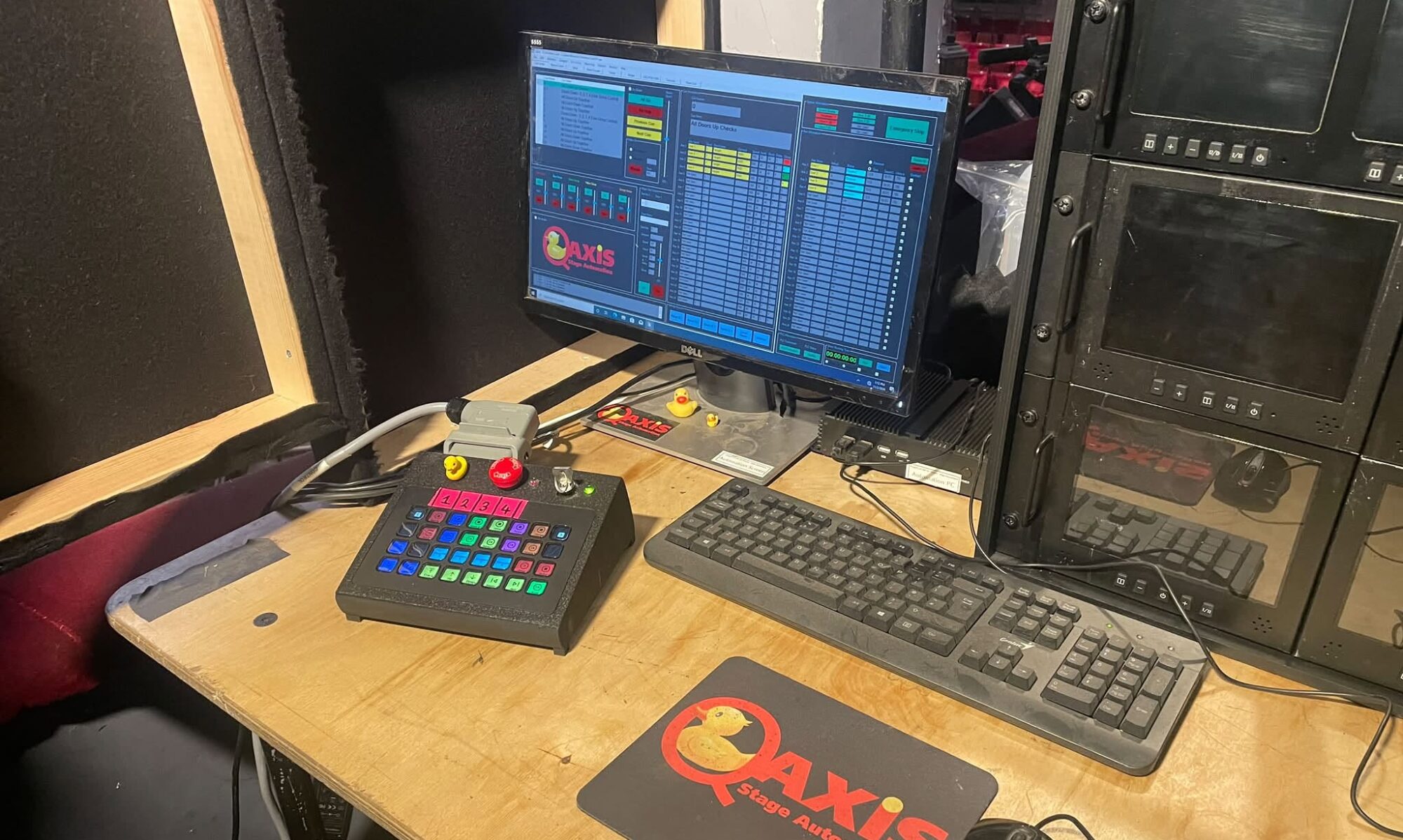
QAxis took a different approach. Using commercially available Omron PLC hardware removed the need to develop our own processor hardware and provided an internationally available platform. I wrote the software, retaining control over how the system worked and developed.
The changeover was measured. The last Impressario job was for Evita in South Africa because I wasn’t yet confident enough to send QAxis that far away. QAxis made its first outing on the Jersey Boys UK tour, with a more manageable location and sufficient lead time.
That has generally been my approach to development: push things far enough to learn, while keeping a route back if something doesn’t work. A production still has to open.
QAxis has since been used on many productions including The Phantom of the Opera in South Korea, The Drifters Girl, Get Up Stand Up!, Jersey Boys, The Wizard of Oz and Operation Mincemeat.
It has faced stronger competition than Impressario did in its earlier years. Being technically better does not automatically make something more commercially successful, one of the lessons of running a small engineering business.
Still a tinkerer
Alongside the main systems, there have been smaller developments: slack rope detectors, load cell amplifiers, encoder breakouts and brake rectifiers. These generally began with a particular project needing a practical solution. Some subsequently became useful products in their own right.
That is probably the part I enjoy most: a problem, an idea, a prototype, and eventually something that works. I still think of myself as a tinkerer.
Thirty years have brought changes in technology, plenty of challenges and the pleasure of seeing machinery do what it was designed to do. They have also brought the opportunity to work with some amazing people.
Thank you to the customers, colleagues, suppliers and friends who have been part of AVW’s story. No control system ever reaches opening night through the efforts of one person alone.
I’m proud of what AVW has contributed. And after thirty years, I still enjoy working out how to make things move.
Anton Woodward


